
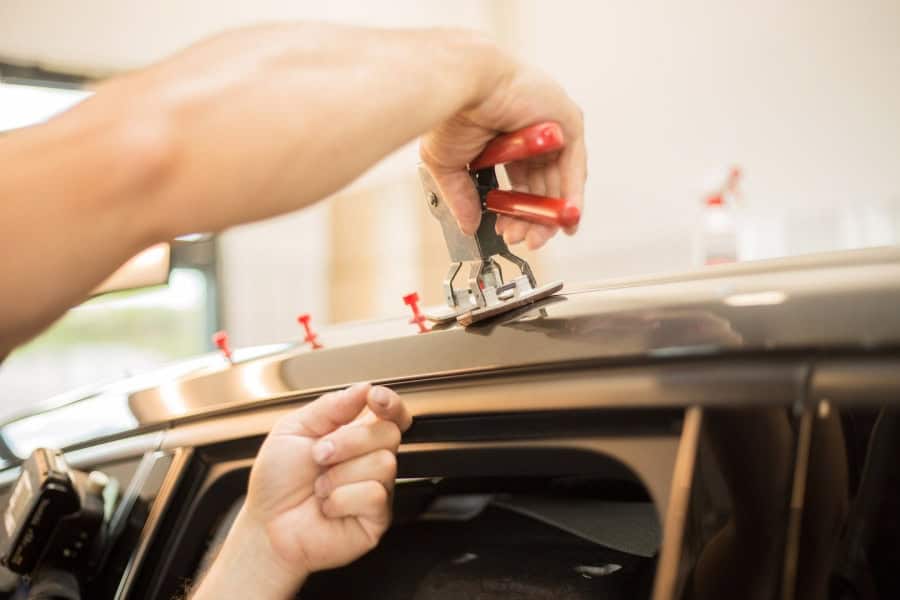
Dentless Paint Repair vs Paintless Dent Repair: What’s the Actual Difference?
If you’ve ever searched for “dentless paint repair” and gotten a bunch of results about “paintless dent repair” instead, you’re not going crazy. We hear this question all the time at our shop, and it’s one of the most common mix-ups in the auto body world. Let’s clear it up once and for all so you know exactly what you’re looking for and what your car actually needs.
“Dentless Paint Repair” and “Paintless Dent Repair” Are the Same Thing
Here’s the short answer: dentless paint repair and paintless dent repair (PDR) describe the exact same service. There’s no separate technique called “dentless paint repair.” It’s just a scrambled version of the real term that caught on because, honestly, the name “paintless dent repair” can be a little confusing on its own.
Think about it. “Paintless dent repair” sounds like you’re repairing a dent that has no paint. But what it really means is you’re repairing a dent without paint. No repainting, no fillers, no sanding. The original factory finish stays completely untouched. That’s the whole point of PDR, and that’s why it’s become the go-to method for fixing minor dents and dings across Austin, Cedar Park, Round Rock, and beyond.
So if you’ve been searching for dentless paint repair near you, you’ve actually been looking for PDR this whole time. And now you know.
How the PDR Process Actually Works
PDR is a hands-on, specialized technique that takes years of training to master. It’s not something you can learn from a YouTube video over the weekend. Here’s what happens when you bring your car to a trained PDR technician.
Inspecting the Damage
First, we take a close look at the dent. We’re checking a few things: the size, the depth, the location on the panel, and whether the paint is still intact. We use specialized lighting (often LED line boards) that helps us see the exact contours of the damage and track our progress as we work.
Accessing the Back of the Panel
The key to PDR is getting behind the dent. We access the backside of the damaged panel, sometimes through existing openings in the body, sometimes by removing interior panels, tail lights, or other components to get a clear path to the metal.
Massaging the Metal Back Into Shape
Using a combination of metal rods, picks, and leverage tools, we apply precise pressure to the backside of the dent. We’re literally pushing the metal back to its original contour, working slowly from the outer edges toward the center. It’s a patient process that requires a steady hand and a good understanding of how sheet metal behaves under pressure.
There’s no filler involved. No sanding. No primer or paint. When it’s done right, the repair is invisible because we haven’t changed anything about the surface of your car. The factory paint stays exactly where the manufacturer put it.
PDR vs Touch Up Paint: Two Completely Different Services
This is where terminology confusion causes real problems. Some people think “dentless paint repair” means fixing paint damage without leaving a dent, or maybe touching up paint chips. Those are completely different services, and it’s worth knowing the distinction.
What PDR Fixes
PDR addresses physical deformations in the metal body panels. We’re talking about:
- Door dings from parking lots
- Hail damage (sometimes dozens or hundreds of small dents)
- Minor creases from shopping carts, bike handlebars, or minor bumps
- Body line dents from low-impact incidents
The paint has to be intact for PDR to work. We’re fixing the shape of the metal underneath, not the surface coating.
What Touch Up Paint Fixes
Touch up paint addresses surface damage to the paint itself:
- Rock chips on the hood or bumper
- Small scratches that have broken through the clear coat
- Paint flaking or peeling in localized areas
Touch up paint doesn’t fix dents at all. It fills in missing paint to prevent rust and improve appearance, but the underlying metal stays however it was.
When You Might Need Both
Sometimes a dent also damages the paint. A sharp impact might leave a crease in the metal AND chip the paint at the point of contact. In cases like that, PDR alone won’t do the job because we need intact paint to work with. You might need the dent repaired first and then touch up work on the paint, or in more severe cases, traditional body shop repair with filler and repainting.
How Long Does PDR Take?
One of the biggest advantages of PDR over traditional body shop repairs is speed. Since we’re not waiting for paint to dry, primer to cure, or filler to set, the turnaround is dramatically faster.
- Small door dings in accessible areas: 30 minutes to an hour
- Medium-sized dents: 1 to 2 hours
- Larger dents or hard-to-reach spots: 2 to 4 hours
- Extensive hail damage (full vehicle): could take a few days depending on severity
Compare that to traditional body shop work, which involves disassembly, sanding, filling, priming, painting, clear coating, and reassembly. That process can take several days to weeks. And you’re paying for all those materials and labor hours on top of it.
When PDR Isn’t the Right Fix
PDR is versatile, but it’s not a magic wand. There are situations where traditional repair is the better call.
The paint is already damaged. If the dent has cracked, chipped, or flaked the paint, PDR can’t restore that surface. The paint needs to be intact for the repair to be seamless.
The metal is stretched or torn. A hard enough impact can actually stretch the sheet metal beyond what PDR tools can correct. If the metal at the dent’s center has been thinned or torn, pushing it back won’t restore the original shape.
Sharp creases. Dents with very sharp edges or hard creases are much harder to work with. The metal along a sharp crease has been stressed in a way that’s difficult to reverse without risking paint damage.
Rust or corrosion. If there’s existing rust under or around the dent, PDR can make it worse. The corroded metal is weaker and less predictable when you’re applying pressure.
Panel edges and reinforced areas. Some spots on a vehicle have double-layered metal or structural reinforcement. These areas limit tool access and make PDR impractical.
The honest move is to have a qualified technician look at the damage and tell you which approach makes sense. A good PDR shop won’t push the service on you if traditional repair is the smarter choice.
Why PDR Is Worth It (Especially in Austin)
Living in Central Texas means your car takes a beating. Between hail season, crowded H-E-B parking lots, and gravel kicked up on 183, dents and dings are practically a fact of life around Austin, Cedar Park, and Round Rock.
PDR makes sense here for a few specific reasons.
It Preserves Your Car’s Value
Your factory paint job is one of the biggest factors in your vehicle’s resale value. The moment you respray a panel, even with a perfect color match, it shows up on a vehicle history or a careful inspection. PDR keeps the original finish, which means no red flags for future buyers.
This matters even more if you drive a newer or higher-end vehicle. Luxury car owners and classic car enthusiasts especially appreciate PDR because it maintains the integrity of the original paint.
It’s More Affordable
No paint means no paint costs. No filler means no filler costs. The labor is specialized, but the materials are minimal. For most minor dents, PDR costs a fraction of what a traditional body shop would charge for the same repair.
It’s Better for the Environment
Traditional auto body repair uses paints, primers, solvents, and other chemicals that release volatile organic compounds (VOCs) into the air. The sanding and prep work generates waste that goes to landfills. PDR skips all of that. No chemicals, no waste, no spray booth energy costs. It’s one of the cleanest repair methods available.
It’s Fast
You can usually get your car back the same day for minor repairs. No rental car needed. No waiting a week for a body shop to fit you in, do the work, and let everything cure.
Common Auto Body Terminology, Decoded
Since we’re already clearing up confusion, here’s a quick glossary of terms that get mixed up:
- Paintless Dent Repair (PDR): Removing dents by manipulating the metal from behind, without repainting. Also mistakenly called “dentless paint repair.”
- Dent Repair Without Painting: Another way to describe PDR. Same thing.
- Touch Up Paint: Applying small amounts of matching paint to chips and scratches. Does not fix dents.
- Paint Chip Repair: Filling in small chips in the paint surface. Does not fix dents.
- Scratch Repair: Buffing out or filling surface scratches. May or may not involve repainting depending on depth.
- Traditional Dent Repair: Body shop repair involving filler (like Bondo), sanding, priming, and repainting. Used for more severe damage.
Get Your Dents Fixed the Right Way in Austin
Whether you’ve been searching for “dentless paint repair” or “paintless dent repair,” you’ve found the right place. Dingz Happen serves Austin, Cedar Park, Round Rock, and the surrounding Central Texas area with professional PDR services that keep your car looking the way it rolled off the lot.
Our technicians have the training and experience to assess your damage honestly and recommend the right repair method. If PDR will do the job, we’ll get it done fast and at a fair price. If your situation calls for something else, we’ll tell you that too.
Ready to get those dents taken care of? Request a free estimate from Dingz Happen today and find out how affordable it is to restore your vehicle’s appearance without repainting a thing.