
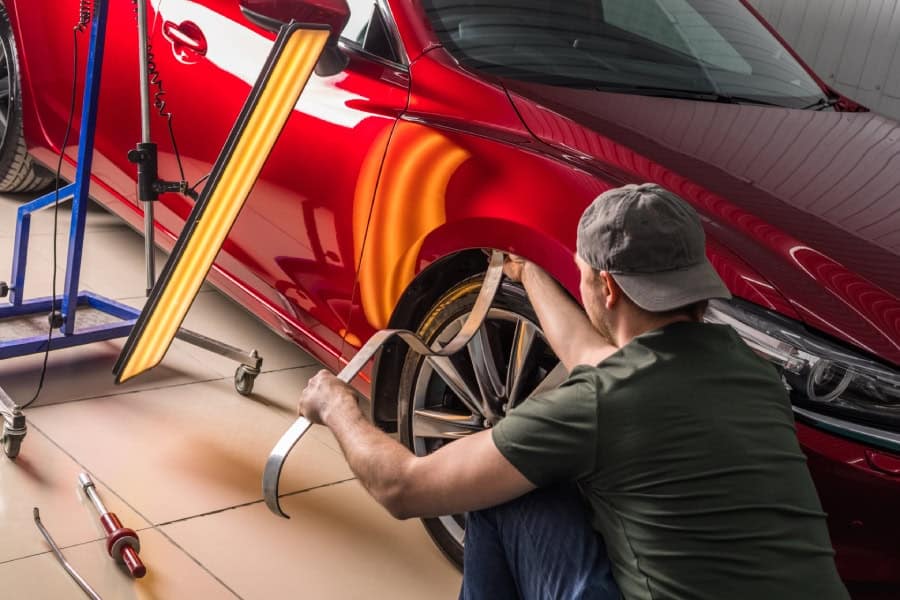
Avoid These Costly DIY Dent Repair Mistakes
Think you can fix that dent yourself? Here’s what actually happens when people try, and why most DIY dent repair attempts end up costing more than just calling a pro.
Why DIY Dent Repair Is So Tempting (And So Risky)
You find a new dent on your car, pull out your phone, and within 30 seconds YouTube has convinced you that a plunger and some hot water will fix everything. We get it. Nobody wants to spend money on something that looks like it should be simple.
But here’s the thing: as PDR technicians in Austin and Cedar Park, we fix botched DIY dent repair jobs almost every week. And almost every time, the repair costs more than it would have if the customer had just brought it to us first. A dent that would’ve been a straightforward $100 fix turns into a $300 or $400 job because someone cracked the clear coat with a heat gun or stretched the metal with a suction cup.
Let’s walk through the most common DIY dent repair mistakes we see, what actually goes wrong, and when it makes sense to call a professional instead.
The “Boiling Water Trick” and Why It Fails
This one’s all over social media. Pour boiling water on a dent, push it out from behind, and your car looks brand new. Sounds easy, right?
Here’s what they don’t show you in those videos. Boiling water dent removal only works on very specific types of dents on plastic bumper covers, and even then, it’s inconsistent. When people try this on metal panels (which is most of your car), nothing happens except you’ve now poured boiling water all over your paint.
The real risk? Thermal shock. Pouring boiling water onto a cold panel can damage the clear coat. We’ve seen cases where the clear coat gets cloudy or develops tiny cracks that aren’t visible right away but show up weeks later as peeling. And once your clear coat is compromised, you’re looking at a repaint. That’s $300 to $600 per panel at a body shop.
The videos that do show “success” are usually working with fresh dents on thin plastic bumper covers where the plastic still has memory. Metal fenders, doors, and quarter panels? Boiling water won’t do a thing.
Suction Cup Dent Pullers: More Harm Than Good
Those $15 suction cup dent puller kits from Amazon look promising. Stick it on, pull, and watch the dent pop out. In reality, here’s what happens:
The dent doesn’t come out evenly. Suction cups apply broad, uncontrolled force. Instead of bringing the metal back to its original shape, they pull the center of the dent out while the edges stay creased. Now you’ve got a bumpy, uneven surface that looks worse than the original dent.
You stretch the metal. This is the big one. Metal has a memory, but it also has limits. When you yank on it with a suction cup, you can stretch it past the point where it can return to its original form. A PDR tech works carefully, applying precise pressure in small increments to coax metal back into shape. A suction cup is like trying to do surgery with a sledgehammer.
You create new high spots. We see this constantly. Someone pulls on a dent too aggressively and now there’s a raised area surrounded by a ring of low spots. Fixing this takes significantly more work than the original dent because we have to address both the highs and the lows.
What would’ve been a $75 to $125 PDR repair can easily become $200 to $350 after a suction cup has distorted the panel.
The Hair Dryer and Dry Ice Method
This is another YouTube favorite. Heat the dent with a hair dryer, then hit it with dry ice or compressed air to rapidly cool it. The theory is that thermal expansion and contraction will pop the dent out.
In practice? A hair dryer dent fix almost never works on metal panels. The temperature differential isn’t enough to move automotive steel. But here’s what it can do:
- Damage your paint. Concentrated heat from a hair dryer (or worse, a heat gun) can soften and blister paint. We’ve pulled dents on cars where the owner used a heat gun and the paint came with it. Now you need paint correction on top of dent repair.
- Crack the clear coat. Rapid temperature changes from dry ice dent repair attempts stress the clear coat. Clear coat damage from DIY heat methods is one of the most common problems we see. The cracks might be microscopic at first, but moisture gets in and the damage spreads.
- Warp plastic trim. If you’re working near plastic trim pieces, door handles, or moldings, heat can warp or melt them. Replacing a door handle or trim piece adds $50 to $150 to your repair bill.
The dry ice method has the added fun factor of potential frostbite and the possibility of damaging your paint from the extreme cold. Car paint doesn’t love being hit with something that’s negative 109 degrees Fahrenheit.
Using Household Tools Instead of PDR Equipment
We’ve seen customers try to push dents out with screwdriver handles, wooden dowels, the back end of a hammer, and once, a golf club. None of these are shaped correctly for dent repair, and all of them can cause serious problems.
Professional PDR tools are specifically designed with tips of varying sizes and curves to match different panel contours. They’re made to distribute force gradually across the damaged area. A screwdriver tip concentrates all that force into one tiny point, which can:
- Poke through the metal on thin panels
- Create small dimples or “pin pricks” visible under direct light
- Scratch the backside of the panel, weakening it
- Chip paint from the inside out
And here’s something most people don’t think about: accessing the back of a panel isn’t as simple as it looks. You often need to remove interior trim, door cards, or tail light assemblies. Doing this incorrectly can break clips, scratch interior panels, and create rattles that are maddening to track down later.
Not Assessing the Damage Before You Start
One of the biggest amateur dent repair mistakes happens before anyone even picks up a tool. Most people don’t properly assess what they’re dealing with.
A dent that looks minor from the outside might be deeper than you think. Professional shops use dent depth gauges and specialized lighting to evaluate damage before deciding on an approach. If a dent is deeper than about a quarter inch, DIY methods are almost guaranteed to fail or make things worse.
You also need to check whether the paint is already cracked or chipped at the dent. If there’s paint damage, pulling on that dent can flake off more paint and turn a small touchup into a full repaint. A PDR tech will spot this immediately. Most DIY’ers don’t even think to look.
And if you’ve got multiple dents from hail or a parking lot incident, don’t just say “fix all the dents” to yourself and start going at it randomly. Map out exactly what you’re dealing with. Count the dents, note which panels they’re on, and check whether any are on body lines or edges where the metal is reinforced and much harder to work.
The Rush Factor: Why Patience Matters
Rushing is probably the single most expensive mistake in DIY dent repair. We get it. You want the dent gone. But PDR is a craft that requires patience and finesse. Professional techs sometimes spend 30 minutes to an hour on a single dent, making tiny adjustments and checking their work under reflection boards between each push.
When you rush, you apply too much force. Too much force stretches metal, cracks paint, and creates secondary damage. Every time you overwork an area, you’re adding complexity and cost to the eventual professional repair.
If you wouldn’t rush through brain surgery, don’t rush through metalwork on a $30,000 vehicle.
PDR vs DIY Cost: The Real Math
Let’s break down what the numbers actually look like:
DIY attempt gone wrong:
– Suction cup kit or DIY tools: $15 to $60
– Clear coat or paint damage from the attempt: $300 to $600 per panel
– Professional PDR to fix the original dent PLUS the new damage: $200 to $400
– Total: $515 to $1,060
Professional PDR from the start:
– Small to medium dent: $75 to $150
– Larger or complex dent: $150 to $300
– Total: $75 to $300
The math isn’t complicated. Professional dent repair costs a fraction of what you’ll spend fixing a failed DIY job. And your car keeps its original factory paint, which matters when it’s time to sell or trade in.
When DIY Might Actually Work
We’re not saying every dent requires a professional. There are a few situations where a careful DIY approach can be okay:
- Tiny dings on plastic bumper covers where you can access the back side and gently push the plastic back into shape
- Very shallow dents (less than a quarter inch deep) on flat, accessible panels where you’re using a proper glue-pull kit (not a suction cup)
- You’ve actually practiced on scrap panels and understand how metal responds to pressure
If the dent is on a body line, if the paint is cracked, if the dent is larger than a golf ball, or if it’s on a panel you can’t easily access from behind, save yourself the headache and call a pro.
Don’t Let a Small Dent Become a Big Problem
Here’s the last thing worth mentioning: dents don’t get better with time. They get worse. Moisture works its way into stressed paint. Small cracks spread. And the longer you drive around thinking about whether to fix it yourself, the more your car’s value drops.
The best move? Get it looked at quickly. A reputable PDR shop will give you an honest assessment and tell you exactly what it’ll cost. No surprises.
At Dingz Happen, we fix dents the right way the first time. We serve Austin, Cedar Park, Round Rock, and the surrounding areas with professional paintless dent repair that preserves your factory finish. Whether it’s a door ding from a parking lot, hail damage, or a crease from a minor collision, we’ve got the tools and experience to make it disappear.
Get a free estimate today. Call us or visit dingzhappen.com to schedule your repair. And if you’ve already tried a DIY fix that didn’t go as planned, don’t worry. We can help with that too.