
The Process of Getting a Paintless Dent Repair Estimate in Cedar Park and Austin
You’ve got a dent. Maybe a door ding from the grocery store parking lot, maybe hail damage from last week’s storm, maybe something you can’t even explain. You’ve heard paintless dent repair can fix it, and you want to know what it’ll cost. But you’ve never done this before, and the whole process feels like a mystery.
It doesn’t have to be. I’ve been doing PDR estimates for years, and I can tell you exactly what happens from the moment you pick up the phone to the moment you drive away with a quote in hand. No surprises, no pressure, no confusion.
How the PDR Estimate Process Starts
Most estimates begin with a phone call or a few photos sent over text or email. You’ll describe where the damage is, roughly how big it looks, and how it happened if you know. Door ding from a parking lot? Hail damage? Shopping cart attack? That context helps us prepare before we ever look at your car.
We can sometimes give you a ballpark range from photos alone, but here’s the thing: photos lie. Lighting, camera angles, and phone quality all change what shows up on screen versus what’s actually going on with the metal. A dent that looks tiny in a photo might have a crease running through it. A dent that looks terrible might actually be a quick fix because it’s shallow and on a flat panel.
That’s why an in-person inspection is always more accurate. And here’s where PDR estimates differ from a traditional body shop visit: most PDR services are mobile. We come to you. Your driveway, your office parking lot, wherever your car sits. You don’t have to drive across town, sit in a waiting room, or burn half your day.
You pick a time that works, and we show up within a 30-minute to one-hour window. Simple as that.
What to Do Before Your Estimate Appointment
Before the technician arrives, there’s one thing you can do that makes a real difference: wash your car. Or at least wash the damaged panels.
This isn’t about appearances. Dirt, road grime, and dust actually hide dent details. A layer of crud can obscure shallow dings entirely, make dents look different than they are, and prevent us from spotting hairline paint cracks that change the repair approach.
You don’t need a full detail. A basic wash with soap and water on the affected areas is plenty. If the damage is on your hood and driver’s door, focus there. The goal is giving the technician a clean surface to work with so nothing gets missed during the inspection.
A clean car means a more accurate estimate. An accurate estimate means no surprises when repair day comes.
What Happens During the Actual PDR Inspection
The technician arrives, introduces themselves, and asks you to show them the damage. This is your chance to point out everything that’s bugging you. Don’t hold back. If you’ve got three dings on the driver’s side and two dents on the passenger door, show them all. We’d rather evaluate everything at once than have you call back later about something you forgot to mention.
Here’s what the tech is actually doing while they look at your car:
Checking Size and Depth
Every dent gets sized up. A quarter-sized door ding is a completely different job than a softball-sized dent on your fender. Shallow dings are faster and easier to work. Deeper dents, especially ones with creases, take more time and more precise tool work.
Evaluating the Paint
PDR works by massaging metal back into shape from behind the panel. That only works if the paint is still intact. The tech checks for cracks, chips, or any paint damage around each dent. If the paint is compromised, that particular dent might need traditional body work instead. A good tech tells you this upfront rather than promising something they can’t deliver.
Assessing Panel Access
This is one of the biggest factors most people don’t think about. To fix a dent with PDR, the technician needs to get behind the panel. Doors, fenders, and hoods usually have straightforward access. But some spots near the frame, along roof edges, or behind reinforcement bars are trickier. Limited access means more time, more creative tool routing, and sometimes specialized equipment.
Using LED Reflection Boards
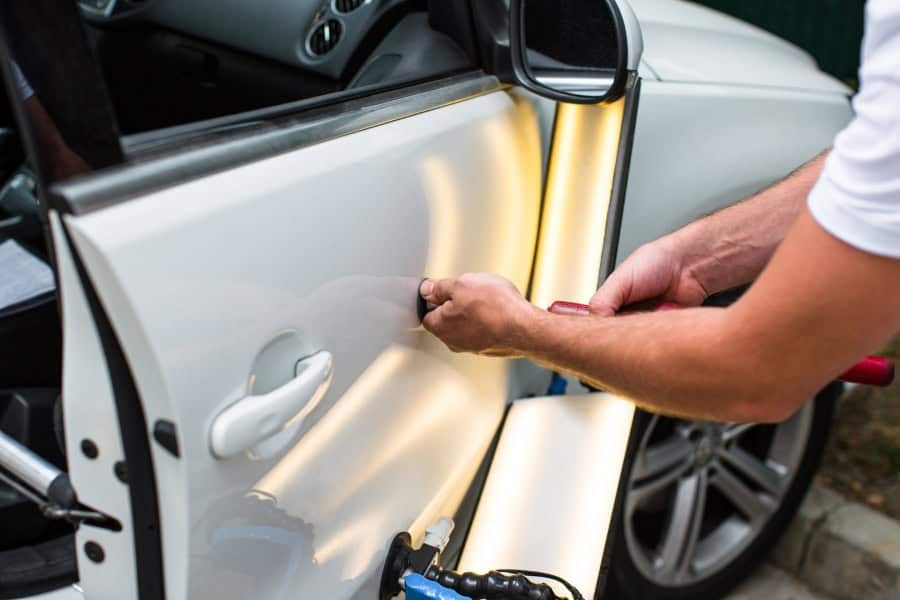
Here’s where it gets interesting. PDR techs use special LED light boards (also called reflection boards or line boards) to see what your eyes can’t. The tech positions the board so light reflects off the damaged area, revealing the true topography of the dent. What looks like one simple ding to your eye might actually have multiple high and low spots that each need individual attention.
These boards turn invisible distortions into clearly visible patterns. Without them, you’re guessing. With them, you can see exactly where every push and pull needs to happen. They’re also how we verify our work is complete during the actual repair.
Counting and Mapping the Damage
If you’ve got hail damage, this step takes longer. The tech maps out every dent across every panel. A hail-damaged car might have dozens of small impacts spread across the roof, hood, trunk, and every body panel. Each one gets noted for size, depth, and location. This comprehensive mapping is what makes the difference between a rough guess and an accurate quote.
The whole inspection typically takes 10 to 15 minutes for a couple of dings. Hail damage or extensive multi-panel work might push that to 20 or 30 minutes. Good techs take their time here because rushing the inspection means missing things, and missing things means inaccurate pricing.
What Affects Your PDR Price
Once the inspection is done, the tech puts together your quote. Here’s what drives the number:
Dent Size
This is the most obvious factor. A dime-sized door ding costs less than a baseball-sized dent. Bigger dents require more pushes, more precision, and more time. A small door ding might run around $100, while a larger dent on a body line could be $175 or more.
Dent Depth
A shallow ding where the metal barely moved is a quick fix. A deep dent where the metal has been significantly displaced takes careful, gradual work to avoid over-correcting or creating new distortions. Deeper means more time, and more time means higher cost.
Location on the Vehicle
Dents on flat, open panels like the middle of a door or the center of a hood are the easiest to repair. Dents near edges, along body lines, close to trim pieces, or in corners require more skill and sometimes specialty tools. Body line dents are particularly tricky because the crease has to be restored perfectly or it’s visible from every angle.
Panel Access
If a tech can pop off an interior panel and get right behind the dent, the job goes faster. If they have to route tools through tight spaces, remove interior components, or work at awkward angles, it adds labor time. Roof dents, for example, sometimes require working through the headliner, which adds complexity.
Number of Dents
Multiple dents mean more work, but there’s usually some efficiency gained. If you’ve got five dings on the same door, the tech is already set up on that panel. Many PDR companies offer package pricing for multi-dent repairs that saves you money compared to fixing each one individually.
Hail Damage
Hail is its own category. A hail-damaged vehicle might have every factor at play: dozens of dents across multiple panels, varying sizes and depths, some in easy spots and some in hard-to-reach areas. Hail repair estimates reflect all of that complexity. They’re typically higher than single-dent repairs, but PDR is still dramatically cheaper than traditional body shop hail repair.
Insurance PDR Estimates vs. Out-of-Pocket
If you’re going through insurance, the estimate process has an extra layer. Insurance companies use standardized pricing matrices to determine what they’ll pay for PDR work. These matrices don’t always match what a shop would charge, and that’s where things can get complicated.
Here’s what you should know. Your insurance adjuster and your PDR technician are looking at the same damage but from different angles. The tech focuses on what it actually takes to fix each dent properly. The adjuster focuses on what the pricing guide says it should cost. Sometimes those numbers align perfectly. Sometimes there’s a gap.
A good PDR shop handles insurance claims regularly and knows how to document damage so your claim gets processed smoothly. They’ll photograph everything, measure dent counts and sizes, and provide detailed breakdowns that speak the adjuster’s language.
If you’re planning to file a claim, have your insurance policy information handy at the estimate. The tech can walk you through whether it makes sense to use insurance (factoring in your deductible) or just pay out of pocket.
Getting Your Quote
After the inspection, you get your numbers right there on the spot. A solid estimate includes the cost for each repair area broken down separately, an estimate of how long the work will take, and available scheduling options.
Transparency matters here. You should understand what you’re paying for. If one dent costs more than another, you should know why. If something can’t be fixed with PDR, the tech should tell you that honestly and, if needed, point you toward a body shop for that specific issue while handling everything else with PDR.
What Happens After You Get Your Estimate
Here’s the part that matters most: a free estimate means zero obligation. You got a professional assessment of your damage and clear pricing. Now you decide.
If the price works and the timing fits, you can book the repair right there. Some jobs can even be done on the spot if the tech’s schedule allows and it’s a straightforward repair. For bigger jobs or busy weeks, you’ll schedule a date that works for both sides.
If you want to think about it, get another estimate, or check with your insurance first, that’s completely fine. A reputable company gives you your quote in writing so you can reference it later. They might follow up in a few days to see if you have questions, but nobody should be pressuring you.
Fleet and Multi-Vehicle Estimates
If you’re managing company vehicles or have multiple cars in the household that need attention, let the PDR company know when you schedule. They’ll block enough time to evaluate everything properly.
Fleet estimates work a little differently. You’ll want to discuss whether repairs can happen at your business location during the workday, how much advance notice is needed, and whether drivers can coordinate directly with the tech. Many PDR companies offer volume discounts for fleet work, so it’s worth asking.
Why Free Estimates Matter
The estimate isn’t just about getting a price. It’s about understanding your options, meeting the person who might work on your car, and getting a feel for whether you trust this company. How a business handles the estimate tells you a lot about how they’ll handle the repair.
Does the tech explain what they’re seeing? Do they answer your questions without rushing? Are they honest about what PDR can and can’t fix? Do they pressure you to commit on the spot? All of these things matter.
Get Your Free PDR Estimate from Dingz Happen
At Dingz Happen, we believe the estimate should be the easiest part of getting your car fixed. We serve Cedar Park, Austin, and the surrounding areas with mobile PDR estimates that come to you. No waiting rooms, no runaround, no pressure.
We’ll inspect your damage with professional LED reflection boards, walk you through exactly what we find, and give you honest pricing on the spot. If something isn’t a good fit for PDR, we’ll tell you. If we can fix it, we’ll show you how and what it’ll cost.
Your car’s dents are bugging you. Let’s figure out what it takes to make them disappear. Contact Dingz Happen today for your free paintless dent repair estimate in Cedar Park or Austin. Call us, text us a photo, or fill out our online form. We’ll get back to you fast.